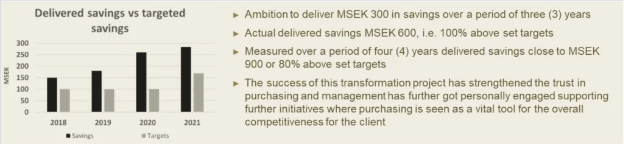
A distributed purchasing organization, an outdated IT service portfolio and weak cooperation between IT and procurement were driving unnecessary cost and limiting business value. Checker Consulting helped the client establish a new IT sourcing strategy, operating model and governance structure — delivering 100% more savings than originally anticipated.
The Challenge
The client had a distributed purchasing organization and had decided to centralize strategic purchasing within a group function. Local purchasing teams would remain in the individual countries but operate under the management and governance of the new group purchasing organization.
Corporate IT was not receiving the level of strategic support it required from IT purchasing. Legacy services remained in place, the IT service portfolio had become outdated, and the supplier base was costly and reactive rather than competitive and forward-looking.
The relationship between the IT and purchasing functions had also deteriorated. There was limited trust, unclear ownership and no consistently applied IT governance process defining how the two functions should work together.
For the CIO, CFO and executive leadership team, the challenge extended beyond reducing supplier costs. The organization needed to:
- Rebuild trust and cooperation between IT and purchasing.
- Establish clear roles, responsibilities and decision rights.
- Modernize the IT service and supplier portfolio.
- Develop the skills required for a strategic IT sourcing function.
- Ensure that future purchasing decisions were fact-based and competitively sourced.
- Deliver tangible savings of MSEK 300 over three years.
Achieving the financial target required a broader IT transformation covering people, processes, governance, capabilities and ways of working.
Checker’s Role
Checker Consulting supported the client in transforming the relationship and operating model between corporate IT and the purchasing organization.
Our role included assessing the current organization, spend, service portfolio, processes and capabilities; defining the future IT operating model; establishing common governance and ways of working; and identifying the competence required within the IT purchasing function.
We also structured and supported a series of sourcing waves designed to deliver measurable savings while implementing the new processes in practice.
This meant that the sourcing initiatives served two purposes: releasing capital and improving the bottom line while simultaneously embedding the new cooperation model between IT and purchasing.
Our Approach
The transformation was structured into four main phases:
1. Assessing the current state
We documented how IT and purchasing were operating, both separately and together.
The assessment covered IT spend, purchasing categories, the existing service and supplier portfolio, organizational capabilities, current processes and ways of working. We also identified what was working well, where cooperation was breaking down and which issues prevented the purchasing organization from providing effective support to corporate IT.
A competence review was conducted to assess whether the IT purchasing organization had the skills and capabilities required to operate as a modern, strategic and forward-looking sourcing function.
The resulting analysis established a fact-based baseline for the transformation.
2. Designing the future state
Working with stakeholders from IT and purchasing, we defined the future IT operating model and IT governance process.
Common processes and ways of working were developed or improved. Roles, responsibilities, interfaces and decision rights were documented and anchored across both functions.
The future state clarified how IT requirements should be developed, how purchasing should support strategic decisions, how suppliers should be evaluated and how the two functions should cooperate throughout the sourcing and contract lifecycle.
The objective was to create a shared model in which IT contributed technical and business requirements while purchasing provided commercial expertise, market knowledge and sourcing discipline.
3. Delivering enabling projects
We identified gaps in the processes, tools and systems supporting IT and purchasing.
Focused enabling projects were then established to address these gaps and give the organization the practical capabilities required to operate according to the future model.
These initiatives supported the implementation of common templates, governance structures, decision processes and working methods. They also ensured that the organization had the right competence and supporting tools to make fact-based purchasing decisions.
4. Executing sourcing waves
A structured series of IT sourcing waves was launched to generate savings, release capital and improve the client’s bottom line.
Each sourcing wave applied the new roles, processes and governance model to a real purchasing initiative. This hands-on approach allowed the organization to implement and refine its new ways of working while simultaneously delivering measurable commercial value.
The sourcing waves also ensured that services and supplier agreements were actively challenged based on cost, performance, business value and market competitiveness.
The Results
The transformation established a stronger and more structured relationship between corporate IT and the group purchasing function.
For the first time, the cooperation was supported by documented processes, agreed responsibilities, clear governance and a shared understanding of who should do what — and when.
The client established:
- A more strategic and capable IT purchasing organization.
- A clearly defined IT operating model for cooperation between IT and purchasing.
- A structured IT governance process with agreed roles and decision rights.
- Common sourcing processes, templates and ways of working.
- A more proactive and competitive approach to the supplier portfolio.
- Fact-based purchasing decisions supported by market competition.
- A repeatable sourcing-wave methodology for delivering financial value.
The financial objective was not only achieved. Through structured sourcing initiatives and disciplined governance, the project delivered 100% more savings than originally anticipated, significantly exceeding the initial MSEK 300 target.
The outcome demonstrated that strategic IT sourcing is not simply a procurement activity. When IT and purchasing operate through a shared model, with clear governance and complementary capabilities, sourcing becomes a powerful instrument for improving control, reducing cost and supporting business transformation.